Insurance Operations
When the system gets in the way
Insurance is complicated by nature. But for the people working inside it, complexity had started becoming friction.
Agents were dealing with outdated portals, disconnected communication, and processes that made simple tasks harder than they needed to be.
The question wasn't simply what should we redesign?
It was:
Where is the experience breaking down, and what would actually make it better?
9
Weeks of discovery
34
One-on-one interviews
246
Survey responses
24
Competitors analyzed
STARTING WITH THE WHOLE EXPERIENCE
I led a nine-week discovery phase to understand the experience from multiple perspectives: employees, agents, and customers.
I didn't want to look at isolated screens or individual interactions. I wanted to understand how everything connected.
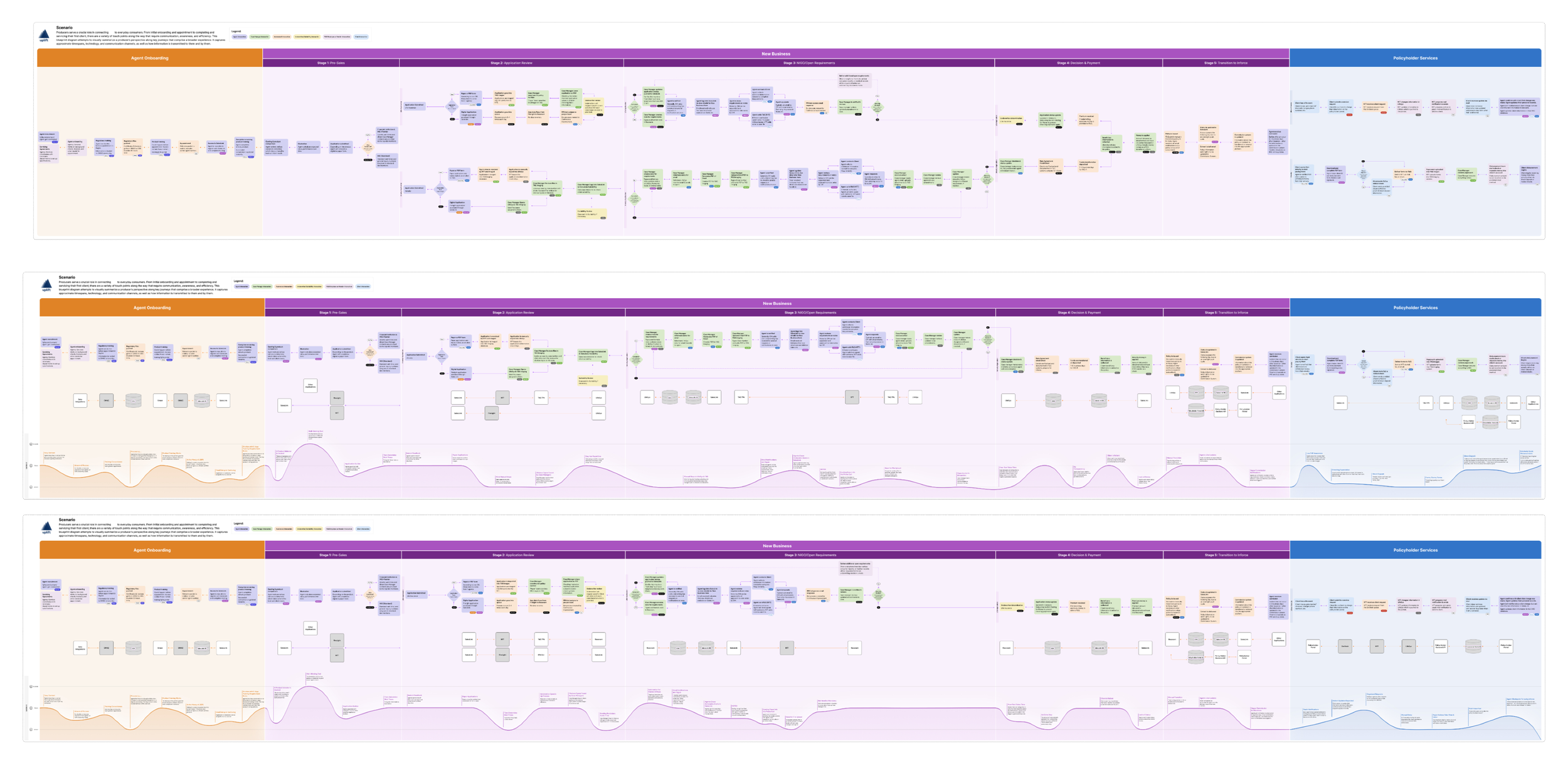
So I combined interviews, surveys, competitive research, focus groups, and service blueprinting to map the experience from end to end.
100+ TOUCHPOINTS LATER...
The service blueprint revealed just how many places the experience could break down.
Information moved between people, portals, systems, and communication channels. Small points of friction accumulated into much larger problems.
Some were obvious.
Others had become so embedded in the process that people had simply learned to work around them.
“The problem wasn't
one bad interaction.
It was the system around it.”
FINDING THE SIGNAL
With research from agents, employees, and customers, I began connecting the individual frustrations to larger patterns.
Three themes emerged:
01
Communication wasn't keeping up with the work
Agents often had to piece together information from disconnected channels, creating uncertainty and unnecessary back-and-forth.
02
Processes were carrying unnecessary weight
Repetitive steps and disconnected systems created operational bottlenecks that slowed applications down.
03
The experience was fragmented
Different groups experienced different parts of the same journey, making it difficult to see where improvements would have the greatest impact.
FROM RESEARCH TO ROADMAP
The goal wasn't to produce a long list of problems.
It was to give the organization a clear way forward.
I translated the research into a strategic roadmap, prioritizing the nine issues with the greatest potential impact and outlining phased opportunities to address them.
The roadmap connected user needs with operational realities and gave product and business teams a shared view of what to tackle first.

WHAT CHANGED
A clearer path through a complicated system.
The recommendations focused on:
01
Better communication
Streamlining how information moved between agents, employees, and customers.
02
Less operational friction
Reducing repetitive work and unnecessary steps in the application process.
03
A better agent experience
Creating clearer, more connected tools that supported agents rather than making them work around the system.
THE TAKEAWAY
This project reminded me that complexity doesn't always live in the interface.
Sometimes it's distributed across people, processes, systems, and communication.
That's why I like starting with the whole experience.
RESEARCH → STRATEGY
My role
Lead Researcher
Methods
Interviews · Surveys · Competitive Research · Focus Groups · Service Blueprinting
Output
Research-backed UX Strategy & Prioritization Roadmap
SEE THE RESEARCH
Some of the deeper research artifacts from this project are tucked away behind a little secret.
MORE WORK
Finding what you're looking for
Product Location Findability →
Rewriting the rules of an old system
Grocery Item Pricing →
Designing for people in a hurry
Convenience Store Checkout →
Designing a shared memory
Internal Knowledge Base →
LET’S WORK TOGETHER
Have a complex system that needs to make more sense?